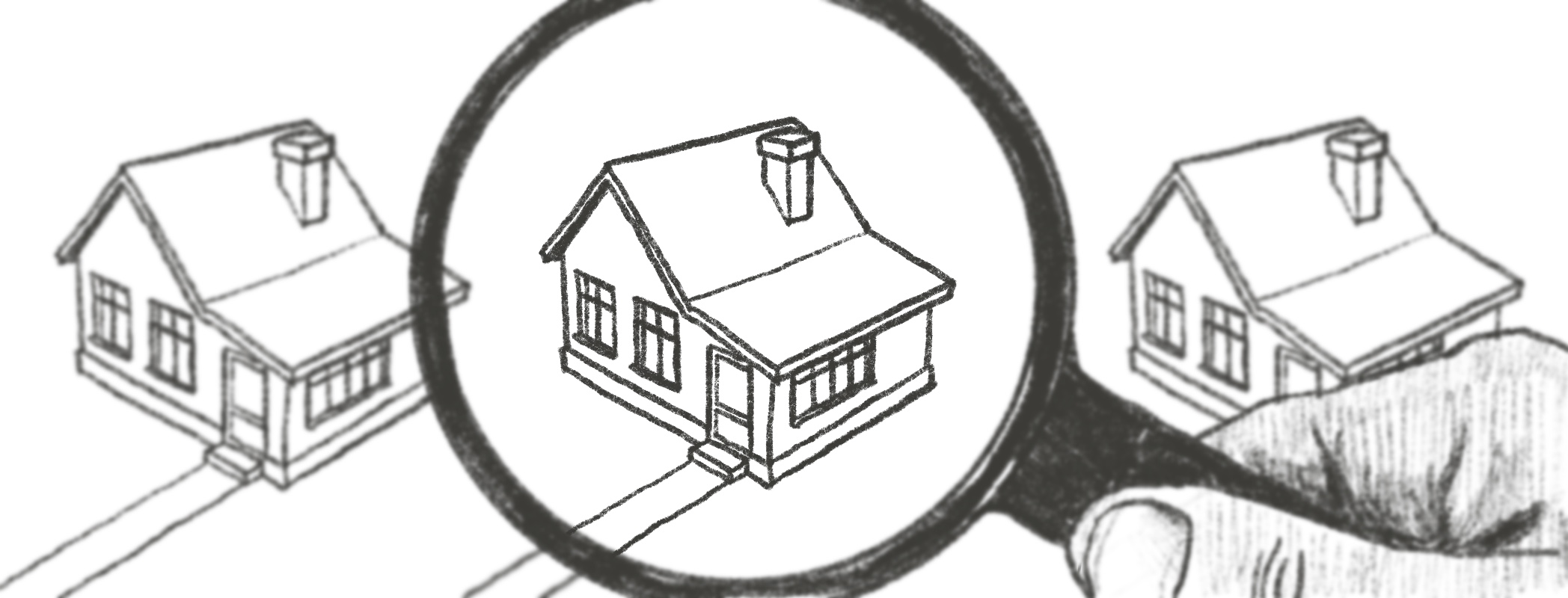
In a world of single-family zoning, we we’re pleasantly surprised to stumble across this recent article in the New York Times highlighting the history of a small New Jersey town and its success with “light-touch density” (LTD): small lot single-family homes, townhouses, triplexes, and fourplexes permitted on land zoned for single-family development.
California has taken a similar approach by allowing similar types of housing development in its single-family zones (i.e. SB 9, SB 10, ADU state laws, etc.) The difference? These New Jersey localities have been allowing this type of development for decades and have now become a “proof of concept” for naysayers.
Looking at this case study of Northern New Jersey localities, we are excited about the future of California’s latest housing bills and specifically, how they can be combined with an older ownership concept: Tenancy in Common (TIC). With this kind of creative approach to density and home ownership, could Los Angeles follow New Jersey and embrace “light-touch density” as a (partial) solution to the current housing crisis?
Looking to New Jersey
Since 1940, Palisades Park has been one of the few towns in New Jersey that chose to implement combined one- and two-family zoning districts with no zones that exclusively permit single-family detached homes. In other words, it has been legal to replace a single-family home with a duplex (similar to the effect of SB 9).
Relative to its neighboring jurisdictions that do not permit
LTD construction, Palisades Park has experienced:
• More housing construction
• Greater population growth
• Higher land values
• Stronger commercial activity
• Lower property tax rates
How is this possible? The town has grown sustainably—a population increase of 40% since 1990 has allowed residents to live more affordably due to housing supply keeping up with demand. The duplexes that are slowly replacing some of the single-family homes are more valuable than the houses, allowing the town to cut property taxes and still have a growing budget for services. And, the new, larger population has supported a revived and flourishing main street.
This case-study illustrates on a micro-scale how by-right LTD can, over the span of decades,
contribute to housing supply growth and affordability. It’s important to note that the success of Palisades Park was not overnight, which is also one of LTD’s main benefits: slow changes allowing communities time to adjust. However, in places like Los Angeles, where people want tangible affordable housing in the immediate future, there has been some push back against similar California legislation (i.e., SB 9).
Is LTD Possible in California?
There have been concerns raised about the sanctity of single-family homes in California. In places like Los Angeles, young families covet the idea of moving into a charming bungalow complete with a large backyard and walking distance to a coffee shop (aka suburban housing with city conveniences).
According to the LA Times, local legislation has been fighting back against density as well. A Los Angeles County Superior Court judge has ruled SB 9 unconstitutional, a decision that could lead to the law being invalidated in the state’s largest cities. This decision currently applies to five SoCal cities: Redondo Beach, Carson, Torrance, Whittier, and Del Mar.
Redondo Beach City Atty. Michael Webb hailed the ruling as a victory for communities fighting against state overreach on housing laws. He specifically states that law makers have passed SB9 and other measures without regard to how such laws would affect the ability to provide water, policing, fire, and other municipal services, and without guaranteeing new development would help those most in need.
Webb also notably said, “SB 9 had all the bad impacts on disrupting the community with none of the positive features of ensuring affordable housing actually be built.”
Is that true though?
Let’s bring it back to New Jersey who did not see rapid development overnight. Please note that although it was originally zoned for two-family dwellings, Palisade Park was primarily developed with single-family detached housing. However, as home prices and land values increased, the city saw progressively more two-family developments, especially side-by-side duplex developments. Again, this took decades for this housing strategy to come to fruition, but what’s important is that the groundwork was there to allow the city to slowly grow with its residents.
Looking at the numbers so far, SB 9’s effects have been muted. Bay Area NPR affiliate KQED recently surveyed 16 cities of varying sizes across California and found that between 2022 and 2023, the cities approved 75 lot split applications and 112 applications for new units under SB 9. Over the same period, those cities permitted 8,800 ADUs, the news organization found.
That doesn’t sound like community disruption, right? As they say, “slow and steady wins the race.”
Looking at Our Own Density
We looked around us, and realized that, for all intents and purposes, much of our neighborhood of Elysian Valley (AKA Frogtown) is already built out to SB9 densities.
The single-family zone in the south half of the area already sports a large number of second houses and duplexes built in the early part of the last century. Surprisingly, quite a few legal lot splits have resulted in minute, half-size corner lots. In addition, over the years, many families illegally converted garages to second units, adding even more density. With the new Accessory Dwelling Unit (ADU) ordinances, this trend has continued in recent years.
Although the neighborhood has recently been targeted by flippers, and housing prices have shot through the roof, the area remains a viable illustration of the likely visual impact of SB9 on other single-family zones. Certainly, the popularity of the area is indicative of the fact that increased density does not negatively impact the desirability of a neighborhood. In fact, like Palisades Park, Elysian Valley, while small, supports a disproportionate number of successful retail and dining establishments
SB9 is not a one-stop solution to the housing crisis (which is a complex issue and requires a complex strategy). However, looking at Palisades and Park and local areas such as Elysian Valley as examples, we think it could be a compromise for areas such as Redondo Beach, which has a history of dragging its feet to meet the state’s low-income housing requirements, to accommodate more housing at a manageable pace with minimal community disruption.
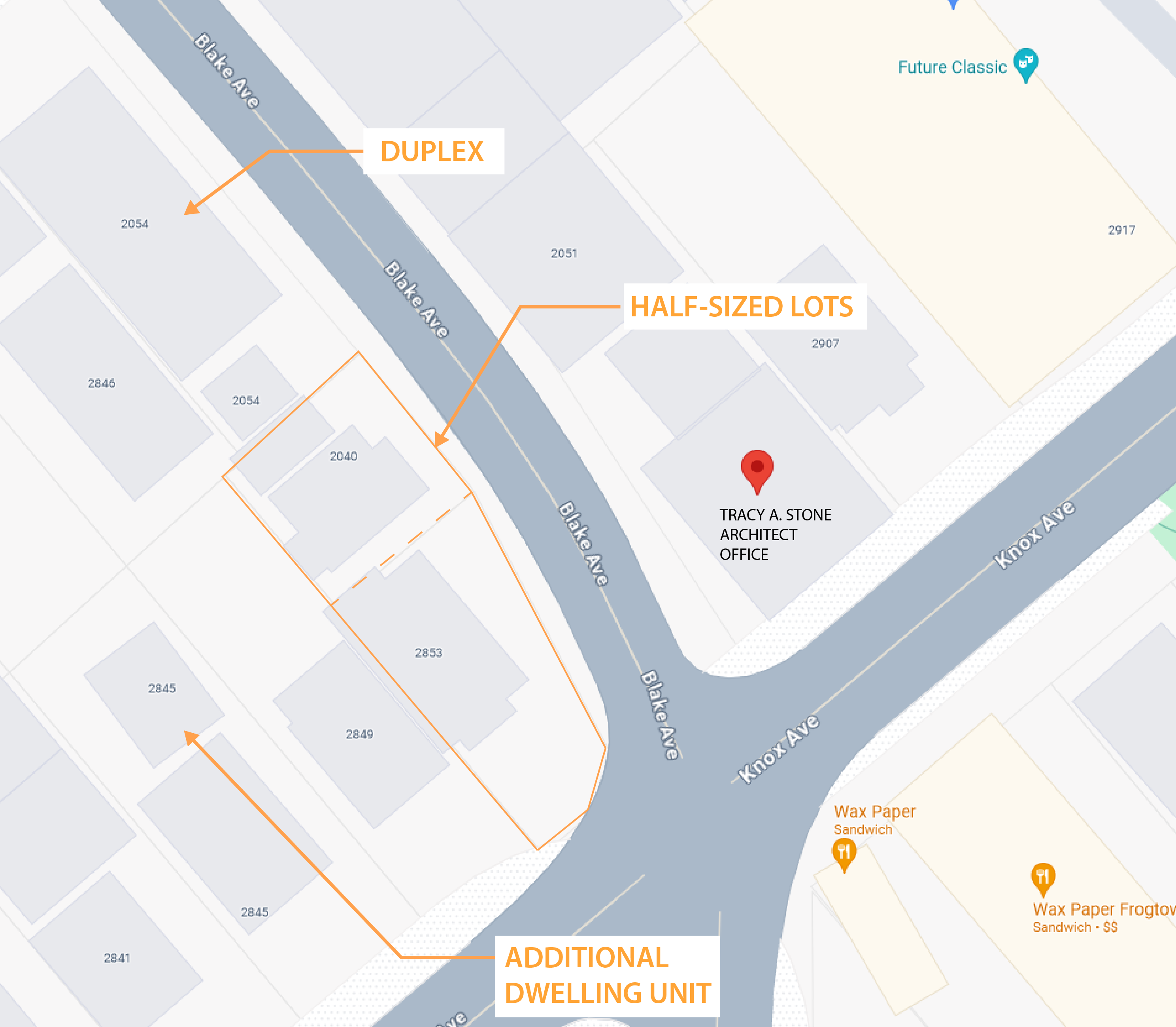
Above: Screenshot of map in Elysian Valley, CA showing the different densities happening on one corner.
How to: Light Touch Density in Practice
Now that we’ve discussed the potential long-term effect of LTD, how do we actually use these laws and what are the benefits?
Currently in California, there are two major legislative options for adding a second unit to a single-family zoned property:
• Add an Accessory Dwelling Unit (following either the State code or the adopted LA version), or
• Use SB9 to add a second unit (house or ADU), with the option to split the lot and add 2 additional units.
Also note that AB 1033, approved in October of 2023, allows property owners to build an ADU and sell it separately following the same process/rules as a condominium. (1). In our opinion, a variation of this; Tenants in Common (TIC), offers a wonderful opportunity for homeowners looking to maximize the value of their properties. By setting up a TIC arrangement with a buyer, the homeowner avoids the legal and procedural complexities of the SB9 subdivision process.
For comparison:
Subdivision/Condominium Process: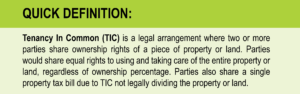
• Preliminary Map (Civil Engineer)
• Public Hearing
• Letter of Determination with city requirements
• Homeowner’s Association
• Final Map (Civil Engineer)
• Record Final Map
Tenants in Common Process:
• Survey to establish property boundaries
• Write Agreement (lawyer)
• Homeowner’s Association
Now before you decide to build an ADU and decide you want to sell it as TIC, there are some caveats, or just some things you should consider:
- Property Ownership: Fractional ownership allows multiple parties to actually own a portion of a property without having to provide enough cash to purchase the entire lot. In the case of a lot with a house and an ADU, both parties will have a partial interest in the entire piece of property (because the lot has not been legally split) with the right to sell their share (defined by a survey) and/or pass it on to their heirs.
- Finding a buyer: Real estate agents may charge a higher commission because these are atypical properties and will take longer to sell.
- Financing the purchase of an ADU: A buyer will not be able to get a normal mortgage to purchase property as Tenants in Common. Only a few banks in Los Angeles offer fractional mortgages.
- The tax assessor: It is important to note that there are property tax ramifications to building and selling a new ADU. The base property value will be reassessed once the ADU is complete. Theoretically, it may be reassessed again, after the sale (although it is worth a call to the tax assessor’s office to confirm). The new tax value can be apportioned to the Tenants in Common (if that is the ownership model used) according to the percentage of the fractional ownership.
Conclusion
Light Touch Density. Do we think it’s a small piece of the large housing crisis puzzle? Yes.
Specifically, it’s a creative solution for cities across SoCal to slowly add density to areas that may be averse to it. Success stories, such as Palisades Park, prove that this is a reasonable strategy that can happen in conjunction with denser affordable housing projects (i.e., multiple housing developments of varying sizes and densities being implemented at the same time).
Are you interested in all the nuances of why we’re in this housing crisis? We’ve covered that:
• Why is Housing in Los Angeles so Expensive? (Part 1)
• Why is Housing in Los Angeles so Expensive? (Part 2)
Are you interested in all the recent legislation implemented to combat said housing crisis? We’ve covered that too:
• Housing Bills 101
• Housing Bills 102
• SB 9 – What does it mean for your single-family neighborhood?
RESOURCES:
(1) Garcia, Karen. “A new law allows homeowner to sell ADUs like condos, boosting homeownership. Here’s how AB 1033 works”, LA Times October 14, 2023, retrieved 6/19/24.
(2) Chen, James. “Tenancy in Common (TIC) Explained: How it Works and Compared to Joint Tenancy” https://www.investopedia.com/terms/t/tenancy_in_common.asp updated 5/31/24. Retrieved 6/19/24
(3) Appelbaum, Binyamin. “This Small New Jersey Town Became a Different Kind of Suburb”, New York Times March 25, 2024. Retrieved 6/1/24 https://www.nytimes.com/2024/03/25/opinion/new-jersey-housing-crisis.html
(4) Sirkin Law – LA office offers legal services to set up fractional ownerships using Tenancy in Common. https://andysirkin.com/practice/tenancy-in-common-tic-with-occupancy-rights/
(5) For more info on Fractional Ownership: https://www.bankrate.com/real-estate/fractional-ownership/
(6) AEI Case Study on Palisades Park and surrounding areas, Chapter 5 – https://www.aei.org/wp-content/uploads/2024/04/Light-touch-density-Compiled-Chapter-5-FINAL.pdf?x85095
(7) Law that Ended Single-Family Zoning is Struck Down for Five Southern California Cities, The Los Angeles Times – https://www.latimes.com/homeless-housing/story/2024-04-29/law-that-ended-single-family-zoning-is-struck-down-for-five-southern-california-cities
(8) New California housing law has done little to encourage new building, The Los Angeles Times
https://www.latimes.com/california/story/2023-01-18/new-california-duplex-law-housing-sb9-homeowners